
 Outline of the Institute
 Faculty and Staff


Crisis Management Seminar
Overseas travel involves a variety of risks, including cultural, linguistic, medical, political, and natural-disaster-related risks. Careful preparation and planned responses are therefore essential. Effective risk management begins before departure, and thorough preparation provides the foundation for a safe and successful overseas experience.
The Institute for International Relations invites outside lecturers twice a year to hold seminars on risk management. Students participating in study abroad programs or overseas language training are strongly encouraged to attend.
Crisis Management Seminar for Study Abroad and Language Training
| Date and Time | Tuesday, January 27, 2026, 18:00-19:30 |
| Location | Ehime University, Johoku Campus Collabo House Hall (Green Hall) |
| Lecturer | JCSOS (Japan Council for Safety of Students Overseas) |
| Target group | Students participating in study abroad, overseas training, and language training (individual travel is also acceptable), accompanying faculty and staff, and parents |
| Application | https://forms.gle/5vv5kvNoyNRqM2Ai7 |
| Remarks | Seminar Poster |
Overseas Travel Kit
The Organization for the Promotion of International Collaboration distributes “Overseas Travel Kits” to students, faculty, and staff, which contain information necessary for overseas travel. If you need a large number of kits at one time, please let us know in advance how many you will need.
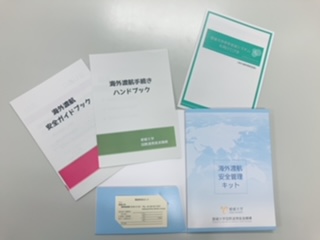
Procedures prior to overseas travel, etc.
Ehime University’s guideline for overseas travel based on Japanese MOFA’s Overseas Travel Safety Information
Please refer to the following table and MOFA’s overseas Travel Safety Information (Japanese only) to determine whether or not students and faculty/staff members may travel overseas. (For university-organized overseas programs, the university will determine whether the overseas travel is permissible. For overseas business trips and overseas training programs, the travel authorization officer of each faculty/graduate school/center will determine whether the overseas travel is permissible.) For private travel, “in principle, suspend” should be interpreted as “in principle, refrain from travel,” and “suspend” as “refrain from travel.”
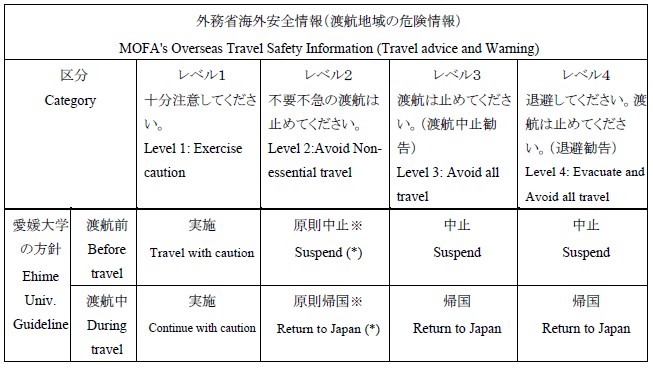
(*)For Level 2, before departure, decisions should be made taking into account the overall safety situation in the destination country or area, and during travel, taking into account local medical conditions, risks on the return journey, and the situation regarding air travel, among other factors.
Submission of Overseas Travel Notification
Ehime University requires students to submit an overseas travel notification to the university before traveling abroad. This is so that the university can quickly confirm the safety of students in the event of a disaster, terrorist attack, infectious disease outbreak, or other emergency overseas. The form must also be submitted in the case of travel abroad or temporary return to one’s home country by international students.
Please register your overseas travel notification on the Study Support System. Please consult with your primary academic advisor or the team in charge of your faculty (or the Student Exchange Team of the International Relations Division) before registering your trip on the system.
In addition, from the viewpoint of risk management, MEXT requires universities to keep track of the whereabouts of all students, regardless of whether they are traveling on university-sponsored programs or not, so please be sure to submit this information even if you are traveling on a private trip for sightseeing or other reasons.
Please refer to the following for the Manual for Study Support System.
Study Support System Portal for Students>Various manuals, etc.
“Ehime University Study Support System User’s Guide” P44~
Registration with the Ministry of Foreign Affairs Overseas Travel Service
Register for one of the following services
When you travel abroad for less than three months, you can register your travel itinerary, accommodation, contact information, etc., and receive the latest overseas safety information for your destination, as well as emergency contact e-mails in the event of an emergency situation.
This is to be submitted to the embassy or consulate-general with jurisdiction over the area by a person staying overseas for more than three months, and is required by Article 16 of the Passport Law. In the event of an incident, accident, or unexpected disaster overseas, the submitted notification of residence will be used to confirm the safety of the notifier and to provide information on the safety of the notifier’s relatives in Japan as quickly as possible. It is possible to submit a notification even if the period of stay is less than 3 months. Only Japanese passport holders are eligible to submit a report.
Informing Relevant Parties
Inform your academic advisor, family members, and other relevant parties that you will be traveling. In particular, inform your family of your itinerary, where you will be staying, and contact information.
Procedures after returning to Japan, etc.
Submission of Overseas Travel Return Notification
Please submit the return notification through the Study Support System as soon as possible after returning to Japan.
Health Considerations After Returning
If you continue to feel unwell after returning to Japan, please seek medical attention immediately. When doing so, please inform them of the area you have traveled to. If you do not know which medical institution you should see, please call the Health Services Center (089-927-9193).